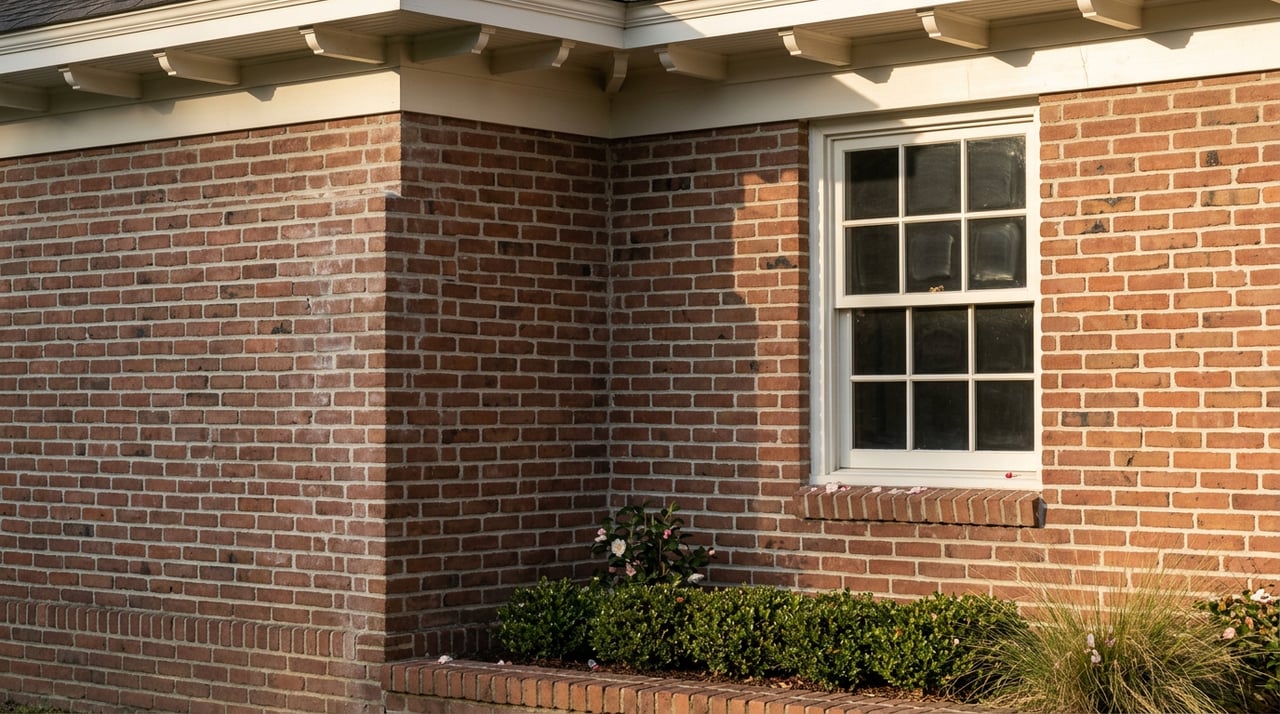
Water was getting into the brick. That was the whole problem, according to the application that came before the Southern Pines Historic District Commission in the summer of 2020. The building's owner wanted to apply a lime wash, a specific product called Classico by Romabio, over unpainted masonry that had never been coated before. The reasoning was straightforward: seal the surface, stop the moisture, protect the structure.
The commission said no.
Not because the diagnosis was wrong. The water damage was real and documented. The commission denied the request because the town's design guidelines are explicit that painting previously unpainted masonry is not a recommended practice within the historic district, and doing so would change the building's appearance in a way the guidelines are built to prevent. A practical fix ran straight into a preservation rule, and the rule won.
That case, filed as HD-17-20 in the commission's own meeting minutes, is the clearest illustration of something buyers rarely learn until they're already under contract on an older Southern Pines home: inside the historic district, the standard for what you're allowed to do isn't whether a change solves your problem. It's whether the change preserves the building's original material and appearance. Those two goals don't always point the same direction, and when they don't, the district's guidelines take precedence over the more convenient fix.
A Bigger Footprint Than Most Buyers Assume
If you've been touring homes near downtown Broad Street, in the curving streets of Weymouth Heights, or anywhere in the blocks built up between the 1880s and 1940, there's a real chance you're already inside the boundary. The Southern Pines Historic District includes 490 contributing buildings along with several contributing sites and structures, spanning architectural styles from Queen Anne to Colonial Revival to Craftsman bungalow. Landmark properties within it include the James Boyd House, Duncraig Manor, Loblolly, and the old Seaboard Air Line Passenger Depot and Freight Station, according to the district's own historical documentation.
That's not a small, quaint pocket of a handful of cottages. It's a substantial share of the town's older housing stock, and it's governed by a body most buyers never think to ask about before they write an offer: the Historic District Commission, a seven-member board whose members serve staggered four-year terms and are required by rule to include a majority with demonstrated experience or education in history or architecture. The town's Historic District Commission reviews applications for construction, alteration, or demolition of any building within the district and issues what's called a Certificate of Appropriateness before that work can proceed.
That certificate requirement is the piece that catches people off guard. It doesn't just apply to additions or teardowns. It applies to more than additions or teardowns.
Major Work Hearings
Not every project goes through the same process.
Major Work applications don't get decided by a staff member checking a box. They go before the commission at a regular meeting, where, as described in the town's 2014 commission agenda, the process runs like a small courtroom: testimony is sworn, criteria under the town's Unified Development Ordinance are weighed one by one, and the commission votes on whether the proposal meets the standard. Public notices for these hearings name the applicant and the parcel, which is how the commission's own records document past examples: a request to construct a 500-square-foot addition and wrap a front porch around a structure on North Ashe Street, exterior alterations to a building on West Pennsylvania Avenue, and a signage request for a property on West New York Avenue.
Why the Rule Exists, and Why It Sometimes Blocks the Obvious Fix
The Pilot, Moore County's local paper, reported in 2025 on a commission discussion that gets at the philosophy behind cases like the lime wash denial. The town has more than 70 historic structures downtown built with details that are genuinely hard to replicate today, features meant to be repaired rather than replaced. The tension the article describes is real: old features age, and aging can create the exact kind of inefficiency, leaks, or drafts that a modern fix would readily solve. But swapping out the original material to solve that problem can compromise the very thing that makes the building historic in the first place.
That's the trade the commission is set up to enforce. It isn't arbitrary and it isn't about taste. It's a standing preference for repair over replacement, even when replacement is the more practical, faster, or cheaper path. If you're buying a home in the district with plans to update windows, re-side an exterior, or address a moisture problem the way you would in any other neighborhood, budget time and money for the possibility that the town's answer will be repair the original material, not replace it with something better suited to the job.
The List Is Still Growing
It's worth being precise about a distinction that gets blurred often: being listed on the National Register of Historic Places is not the same thing as being inside the town's local historic district. The National Register is largely an honorary designation tied to eligibility for certain tax incentives, while the Certificate of Appropriateness requirement comes specifically from the town's own Unified Development Ordinance and the local district it establishes. A property can be on the National Register without needing a COA for a paint color, and a property inside the local historic district needs one regardless of whether it holds any national designation.
That said, the two lists tend to grow in the same direction. The North Carolina Department of Natural and Cultural Resources announced in April 2026 that two Southern Pines properties, Our Lady of Victory Catholic Parish and Trinity AME Zion Church, had recently been added to the National Register, listed in December 2025 and August 2025 respectively. Neither addition changes what the local Historic District Commission reviews, but it's a signal that preservation activity in Southern Pines hasn't slowed down. If anything, the town's inventory of protected and recognized structures keeps expanding, which means the odds of your next older home falling inside some layer of review are rising, not falling.
What This Actually Means Before You Make an Offer
None of this should scare a buyer away from an older Southern Pines home. It should change what you ask before you fall for one. Before you get attached to a listing near downtown or in one of the older residential pockets, ask whether the parcel sits inside the local historic district boundary, not just whether it looks old. Ask what exterior changes you're picturing, whether it's new windows, a porch addition, or repainting brick, and what review those specific changes would require.
The town's Planning Department fields these questions directly and can tell you early whether a property falls inside the boundary. That's a five-minute call that can save months of assuming a fix is simple when the guidelines say otherwise.
An older home in Southern Pines carries a kind of character you can't manufacture in new construction. It also carries a process most buyers don't see coming until they're already living with it. Knowing which one you're signing up for, before the offer goes in, is the difference between a smooth renovation and a Major Work hearing you didn't plan for.
If you're weighing a historic property against a newer build in Southern Pines, or you just want a straight answer about what a specific address would require before you write an offer, Rhonda Edwards can walk the details with you and help you get a clear picture of what you're actually buying.
This article is general information, not legal, tax or financial advice. Consult a qualified professional about your situation.