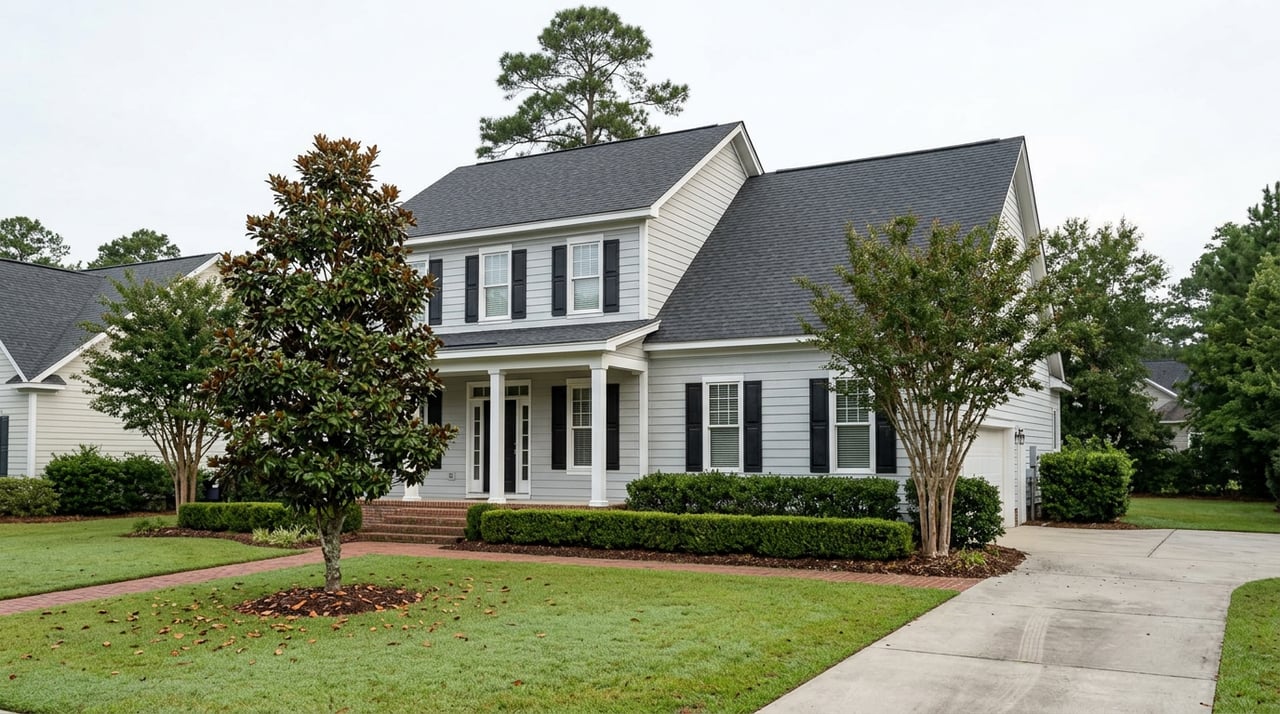
Which town costs more to own in, Pinehurst or Southern Pines? Most buyers answer that question with the only number they've seen: list price. Pinehurst reads as the pricier, more polished address, home to golf courses and a National Historic Landmark district. Southern Pines reads as the more attainable, walkable alternative. So the assumption follows naturally: pay more for the Pinehurst address, pay more to own it.
Moore County's own tax records tell a different story. For fiscal year 2026-27, the Village of Pinehurst's combined property tax rate sits at $0.5525 per $100 of assessed value. Southern Pines sits at $0.6225. Pinehurst, the town with the fancier reputation, actually charges seven cents less per hundred dollars of value than Southern Pines does. That gap is small on paper and real on a tax bill, and it says something the price-per-square-foot comparisons on the portals don't: the town that costs more to live in isn't necessarily the town with the higher list price.
Where the Number Actually Comes From
Every property in Moore County pays the same county levy, currently $0.2900 per $100 of assessed value for FY2026-27, adopted as part of the county's budget ordinance for the fiscal year that started July 1, 2026. That part of the bill doesn't change based on which town you buy in.
What changes is what gets layered on top. Inside the Village of Pinehurst, most parcels pay that $0.2900 county rate plus a $0.2200 municipal levy plus a $0.0425 district charge, landing at $0.5525 combined. Inside Southern Pines, the same county rate applies, but the town's own levy and district charges stack to a combined $0.6225. Since the county piece is identical for both, the entire seven-cent gap comes down to how each town has chosen to fund itself on top of that shared base.
The Village of Pinehurst's own government describes its municipal rate as the lowest of any incorporated town in Moore County. That's not a marketing line, it's a rate comparison the town publishes itself, and the FY2026-27 numbers back it up.
What Seven Cents Actually Costs You
Seven cents per $100 sounds trivial until you run it against real home values in these two markets.
- On a $450,000 home, a move-up family's likely price point in either town, the gap works out to about $315 a year.
- On a $650,000 home, closer to what a lot of golf-community listings in Pinehurst carry, the gap runs closer to $455 a year.
- On a $750,000 home, the gap approaches $525 a year.
None of these numbers will decide a purchase on their own. But they're the kind of detail that matters most to the buyer already comparing two towns line by line, particularly a retiree on a fixed income or a second-home buyer running the math on carrying costs before they run it on a mortgage. A few hundred dollars a year is real money over a ten or twenty year hold, and it runs in the opposite direction of what the sticker prices suggest.
| Moore County levy | Municipal + district levy | Combined FY2026-27 rate | |
|---|---|---|---|
| Village of Pinehurst | $0.2900 | $0.2625 ($0.2200 municipal + $0.0425 district) | $0.5525 |
| Southern Pines | $0.2900 | $0.3325 | $0.6225 |
The shared county rate is identical for both towns. Every cent of the seven-cent gap between them comes from what each town layers on top of it.
Why the Gap Exists
Property tax rates aren't set by the market. They're set by a town council deciding how much revenue it needs and dividing that by the value of everything taxable within its limits. A town with a larger commercial tax base, more infrastructure obligations, or different service costs will land on a different number than a neighboring town with a smaller footprint and a leaner budget, regardless of how expensive the homes inside either town happen to be.
That's the piece worth sitting with if you're comparing Pinehurst and Southern Pines on more than curb appeal. Pinehurst's reputation as the higher-end address doesn't obligate it to a higher tax rate, and Southern Pines' reputation as the more approachable option doesn't guarantee a lower one. The rate is a budget decision made independently of what any given house happens to be worth. Two homes priced identically in these two towns can carry meaningfully different annual tax bills, and the direction of that difference runs opposite to what most buyers assume walking in.
The Clock That Matters More Than the Rate
According to Moore County, its last countywide revaluation took effect January 1, 2023, and the next one is scheduled for 2027. According to Triangle Tax Map, rates themselves are re-adopted every June for the fiscal year that starts July 1, which is why the FY2026-27 numbers above are the ones currently in effect.
Here's the distinction worth understanding before that 2027 revaluation lands: a countywide revaluation resets assessed values, the number your rate gets multiplied against, not the rate itself. The seven-cent gap between Pinehurst and Southern Pines is a function of each town's own budget choices, not the county's valuation cycle. A revaluation could shift what your home is assessed at, but it won't automatically close or widen the gap between what the two towns charge on top of that value. That's a separate decision each town council makes on its own timeline.
For a buyer weighing these two towns today, that means the comparison in this piece is one you can rely on through the current fiscal year at minimum, and likely well past it unless one town's council votes to change its own rate before the next scheduled adjustment.
What This Means If You're Comparing the Two Towns
If you're deciding between a home in Pinehurst and a comparably priced home in Southern Pines, the tax line is worth pulling up before you finalize a budget, not after. It won't be the deciding factor for most buyers. Neighborhood fit, commute, amenities, and the home itself will carry more weight than a few hundred dollars a year. But it's the kind of detail that changes a monthly carrying-cost spreadsheet just enough to matter, especially for buyers stretching to a specific number or comparing two finalists at similar price points.
A Few Common Questions
Does a higher list price always mean a higher tax bill? Not necessarily. Your tax bill is your assessed value multiplied by your combined rate, and the rate depends on which town and district you're in, not on what you paid for the house.
Will these rates change before the next revaluation in 2027? Rates are re-adopted every June for the coming fiscal year, so it's possible for a town to adjust its own levy before the 2027 reassessment. The county-county base and the current town rates cited here reflect the FY2026-27 numbers in effect now.
How do I check the exact rate on a specific address? Moore County's Tax Department maintains parcel-level records, and both towns publish their adopted rates as part of their annual budget documents. Confirming the exact combined rate for a specific property before closing is worth the five minutes it takes.
Comparing two towns on more than the number in the listing photo is exactly the kind of homework that pays off before you write an offer, not after. If you're weighing Pinehurst against Southern Pines, or trying to figure out what a specific address will actually cost you to hold long term, Rhonda Edwards has spent her life in these neighborhoods and can walk you through the numbers that don't show up on the listing page. Reach out for a home valuation and a straight answer on what ownership actually costs where you're looking.
This article is general information, not legal, tax or financial advice. Consult a qualified professional about your situation.